
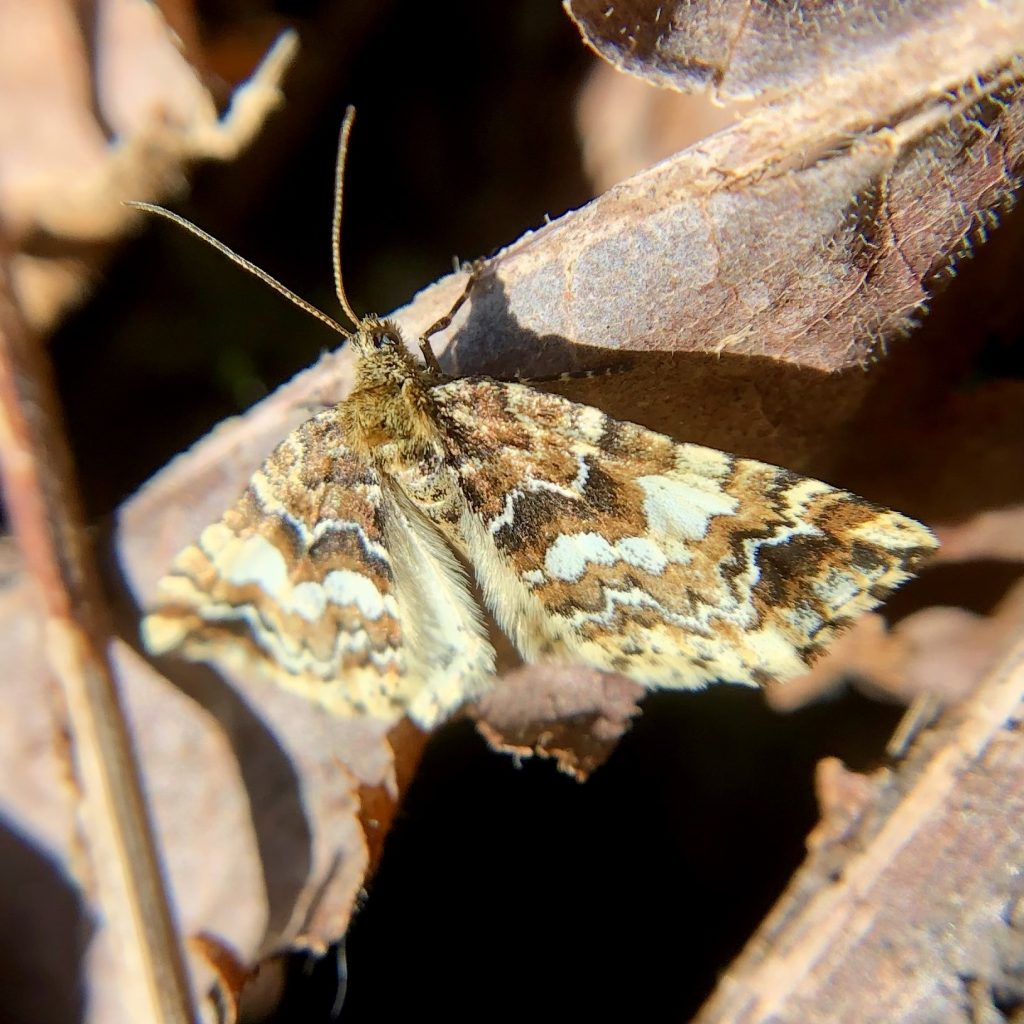
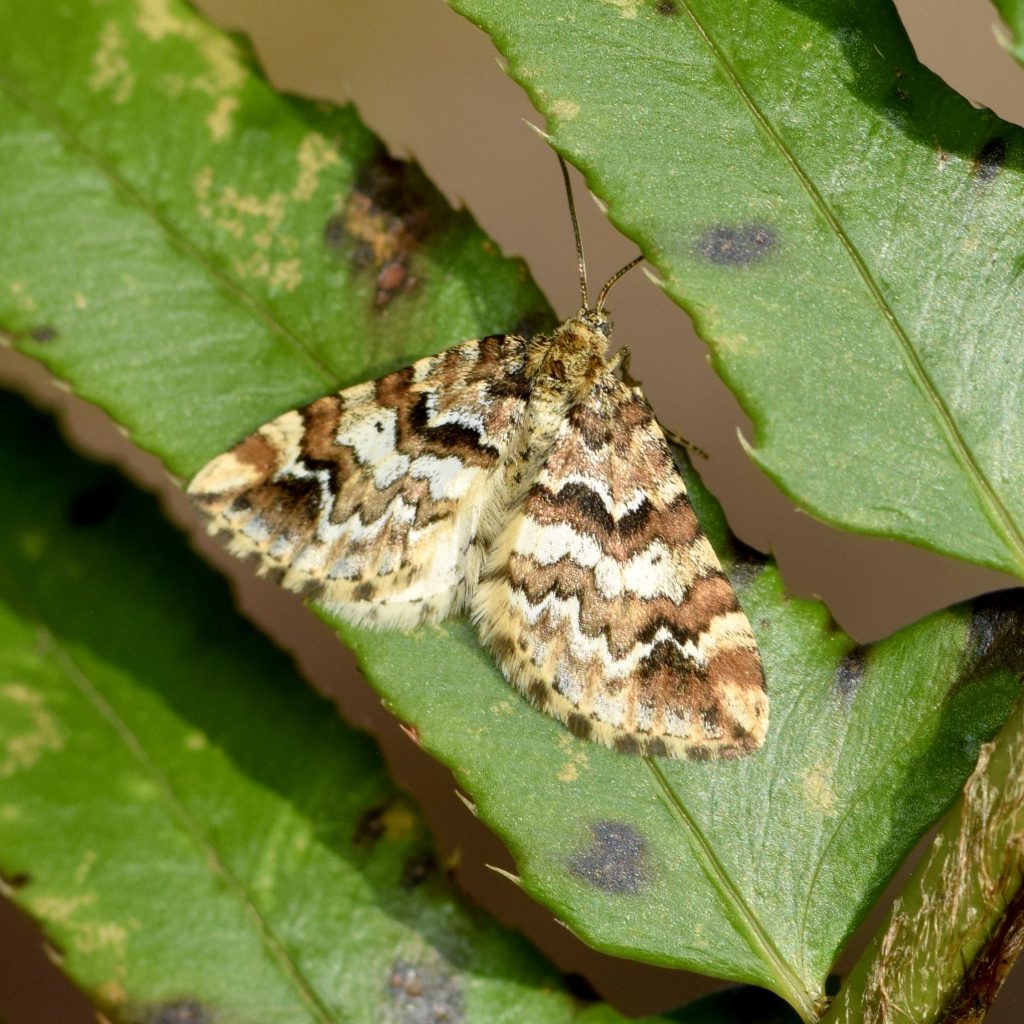
One sure sign of spring at Mount Pisgah is also sure to frustrate anyone trying to get a close look at it: the flitting figure of an Enchoria lacteata moth. These daytime fliers are all over some of the wooded areas lately, but they rarely rest.
Their cream-colored hind and under-wings, which catch the eye when they’re flying, live up to the species name (lacteata = milky). The upper wings, which are what’s visible when they land, feature lush, wavy stripes in shades of buff, walnut and chocolate. The soft zig-zag pattern looks like a cozy weaving or rug. A small dark dot in the middle of a central off-white stripe is a good indicator of the species, though it’s nearly invisible on the first moth pictured here.
Why do these small (1 cm) moths fly so early? Because they’re connected to some early-leafing and -blooming flowers. The profile of Enchoria lacteata linked below says the adults sip the nectar of Western Sweet Coltsfoot and Miner’s Lettuce blooms, and females lay eggs on those plants, where the subsequent larvae then find shelter and nourishment.
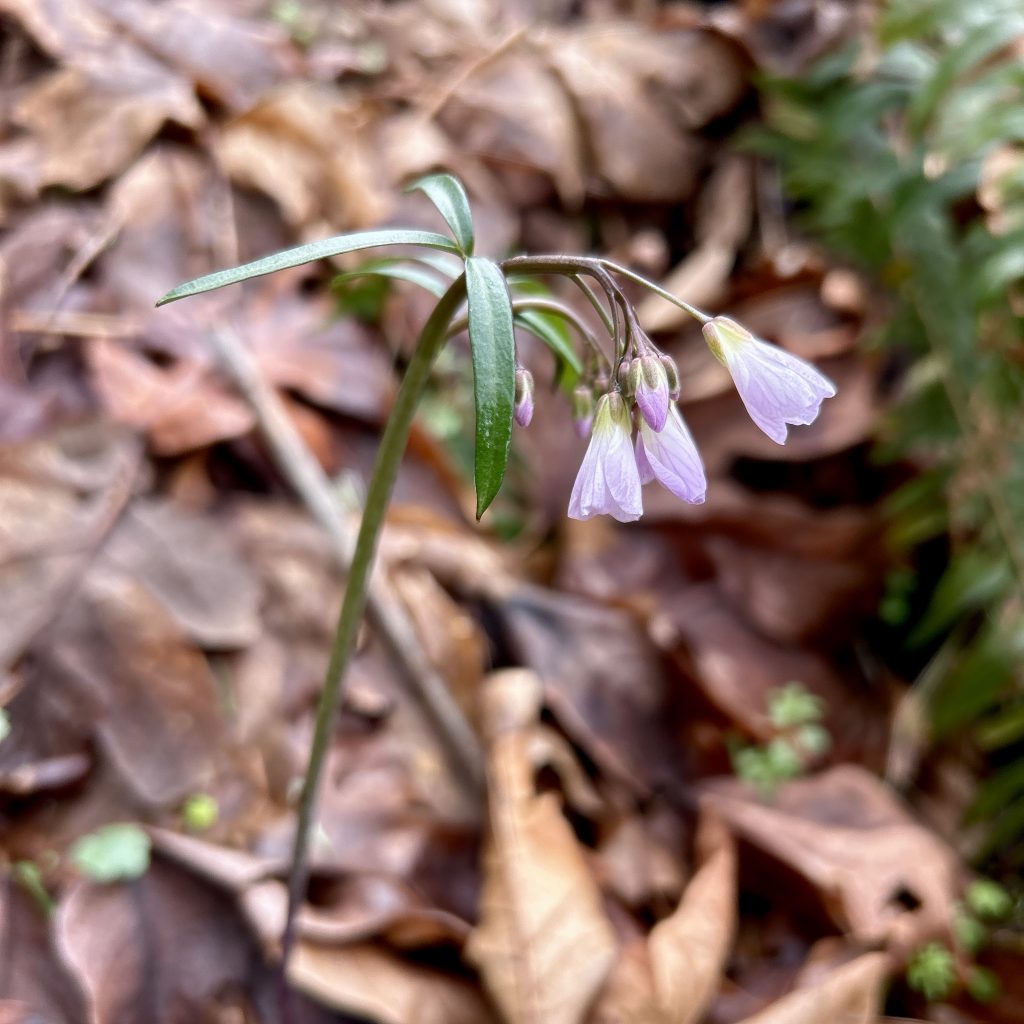
I went looking for the host plants above, but couldn’t find them near where I’d spotted these moths. iNaturalist confirms Claytonia perfoliata, or Miner’s Lettuce, does grow in the arboretum, but it won’t flower until later in the season. I did find a blooming Nuttall’s Toothwort, or Cardamine nuttallii (pictured here), which another source lists as a host for the moth.
Regardless, I’m going to keep my eyes open for Miner’s Lettuce. It’s been an important food for native people for millennia, but the common name comes from the nutrition it supplied during the California gold rush. The vitamin C content is so high that prospectors ate it to prevent scurvy. All parts of the plant are edible, though some need to be cooked, and one source I found calls it a vegetable.
Neither iNaturalist nor BugGuide has any pictures of Enchoria lacteata caterpillars. Because it’s in the Geometrid family, they’re certainly of the inchworm form, and move in a head-to-toe, measuring mode. To me, the lack of photo evidence offers yet another insect opportunity: Plant some Miner’s Lettuce in your yard and keep an eye on the insects that use it … maybe you can snap a photo of the elusive larvae.
Stay curious!
See more of Karen’s work here.
Sources:
Information on miner’s lettuce: https://www.douglascountymg.org/mg_articles/MinersLettuce.pdf Accessed 3/5/26.
Profile of Enchoria lacteata: http://10000thingsofthepnw.com/2021/03/14/enchoria-lacteata/ Accessed 3/5/26.
All photos by Karen Richards.