
In the last column, you met a beetle that poses as a wasp. This time, it’s a moth wearing the wasp costume.
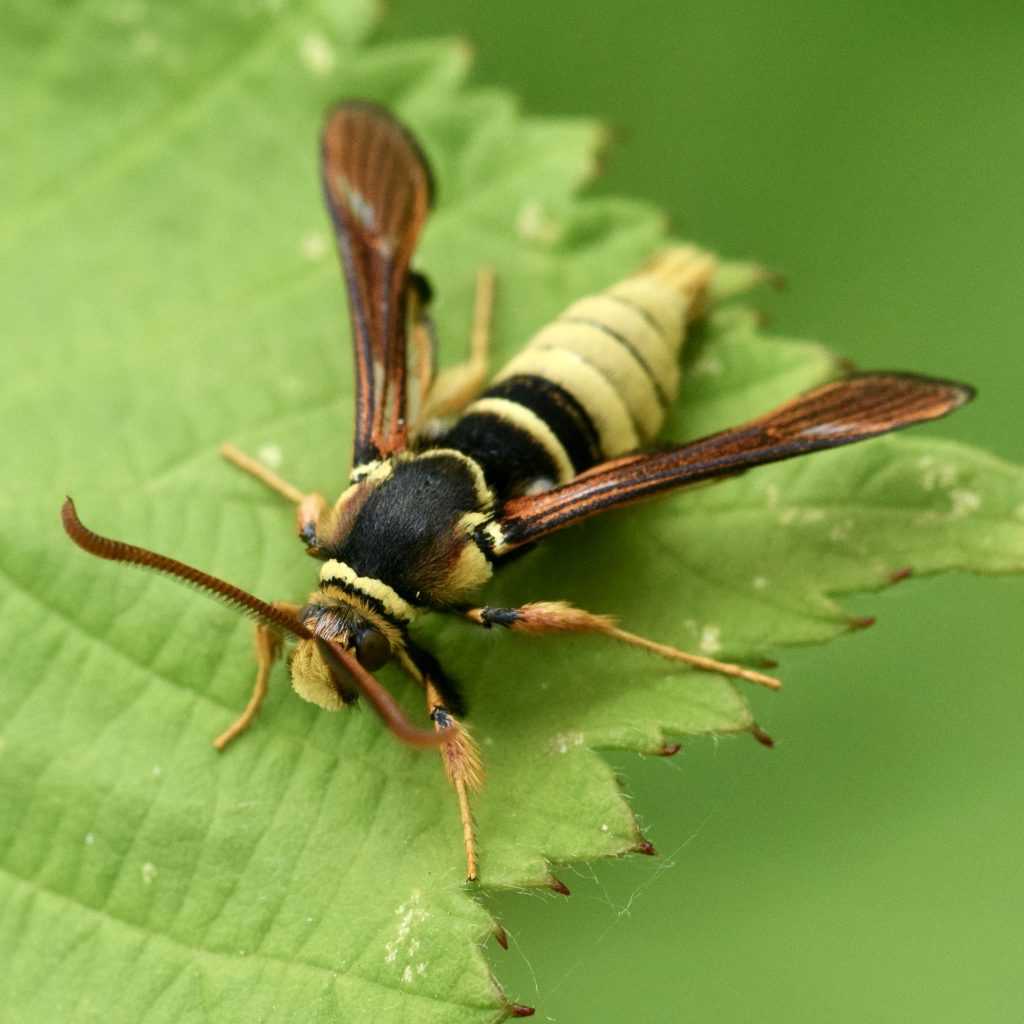
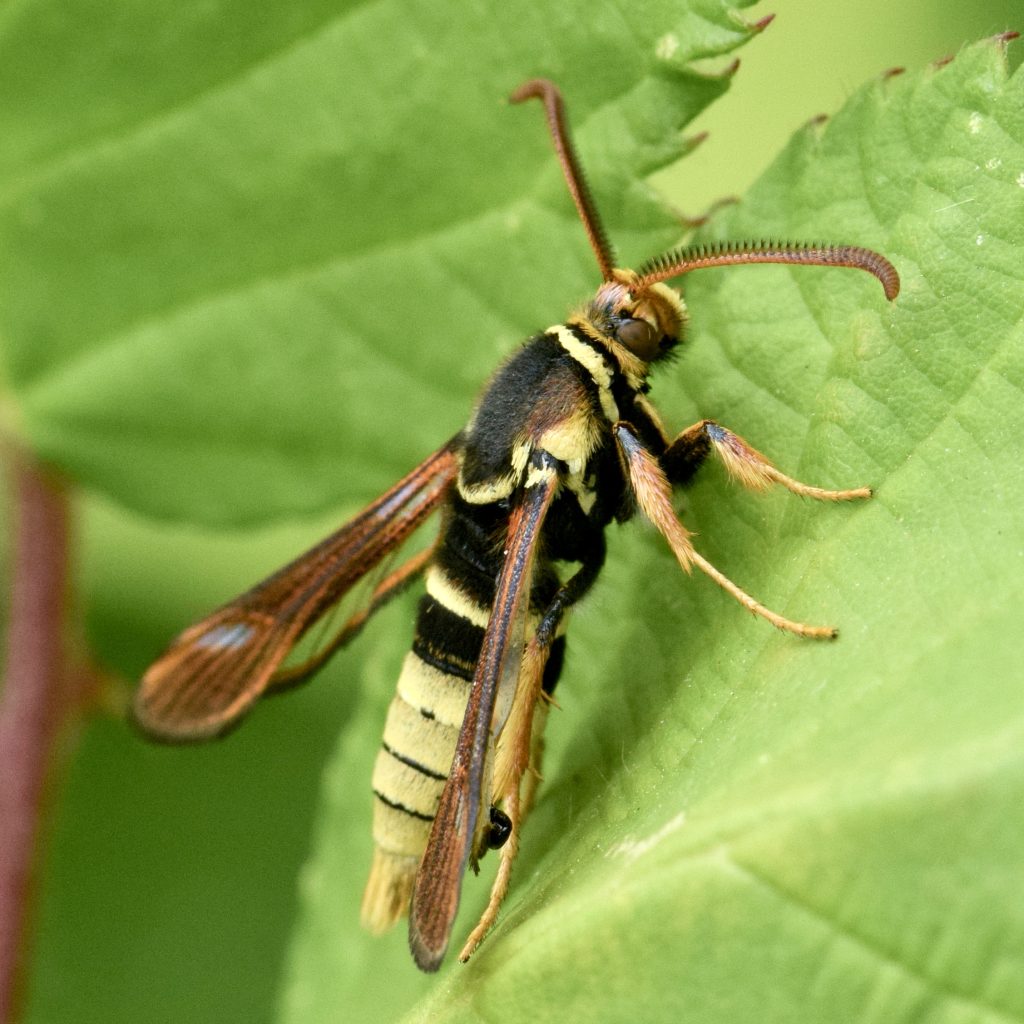
The Western Poplar Clearwing, or Parathene robiniae, imitates a paper wasp, and from a distance, that’s what I thought it was. But up close, the feathery antennae, velvety body, and fan-like tail give it away.
Its colors are stunning. The wings are a rich brick red, the abdomen Crayola yellow, and the hairs between its eyes and on its front legs are full-on punk pink.
Poplar is in the common name because the larvae eat the wood inside poplar trees, but they also target aspen and willow, the latter of which is probably why this one was hanging out near the river at Mount Pisgah.
They’re called clearwings because the second set of wings don’t have scales. In fact, the upper wings feature light blue patches that echo the lower, see-through wings.
Sightings of this moth are pretty rare. Even though they live across the entire western U.S. and Canada, there are only 360 observations on iNaturalist. Some look different from this one: The bodies may be brick red, brown, or more faded and uniformly yellow.
Parathene robiniae are large for the genus, with a wingspan of two to three centimeters.
You may notice a black blob under this one’s right wing. I think that might be part of the moth’s pupal case, and that it may have recently emerged when I saw it.
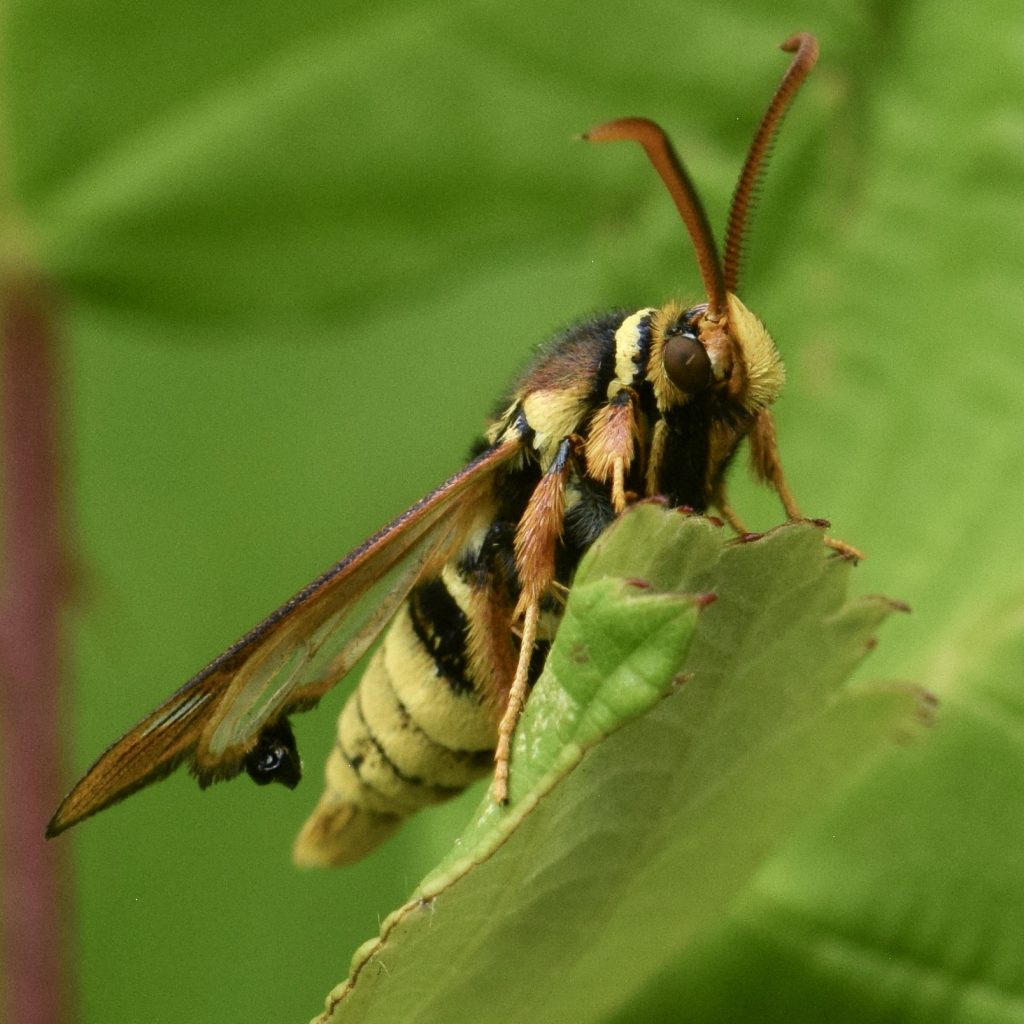
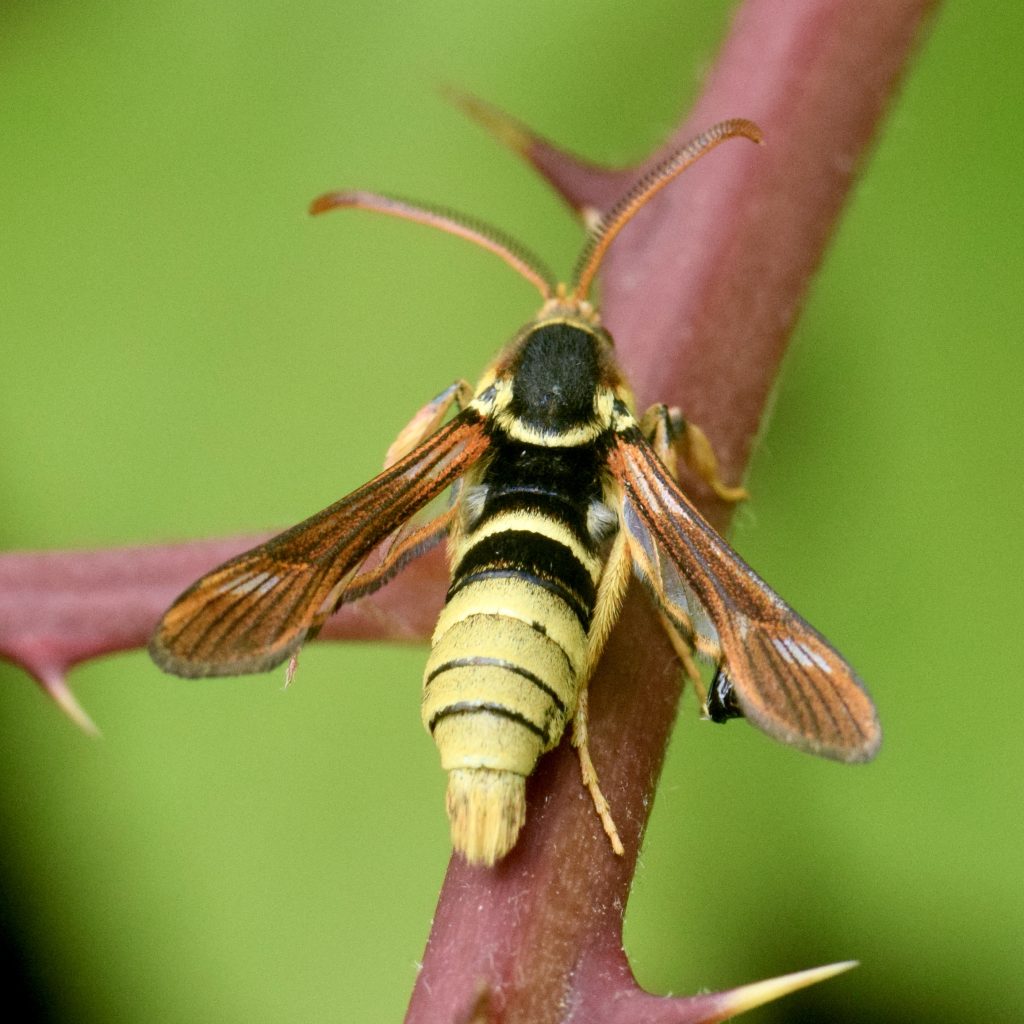
But here’s the sting of these attractive, non-stinging creatures: Just one moth larvae can kill a sapling tree. That’s why they can become problematic for nurseries that raise poplars. A dissertation from Washington State University (linked below) looked into controlling the moths, and found pheromone lures to be useful.
I don’t think the presence of this moth is a threat to the willows along the Coast Fork of the Willamette, simply because Western Poplar Clearwings are fairly rare.
Stay curious!
See more of Karen’s work here.
Sources:
Washington State University paper on controlling Parathene robiniae in nurseries: https://rex.libraries.wsu.edu/esploro/outputs/doctoral/Biology-and-control-of-the-Western/99901054530601842. Accessed 7/14/26.
Webpage describing several west coast clearwing moths, including the Western Poplar Clearwing: https://ipm.ucanr.edu/home-and-landscape/clearwing-moths/#gsc.tab=0 Accessed 7/14/26.
All photos by Karen Richards.