
On a recent insect walk at Mount Pisgah, I was all eyes when someone spotted this red-spotted beetle. So was the beetle — it has four of them, a trait that’s reflected in the genus of its scientific name: Tetraopes femoratus.
Most longhorn beetles, named for their oversized antennae, have eyes that are interrupted by the stalk of the “horns.” But the antennae on these beetles go to the extreme. They sit in the middle of each eye, splitting them in two.
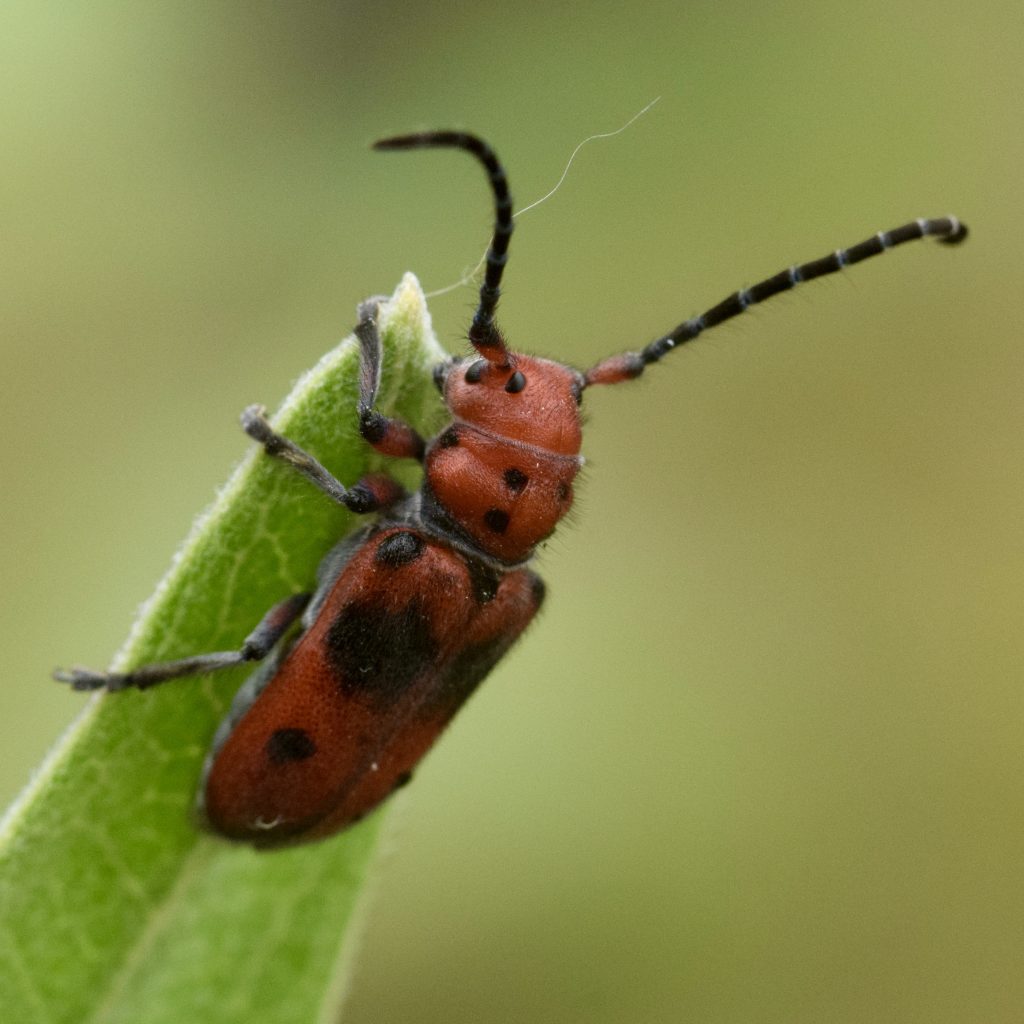
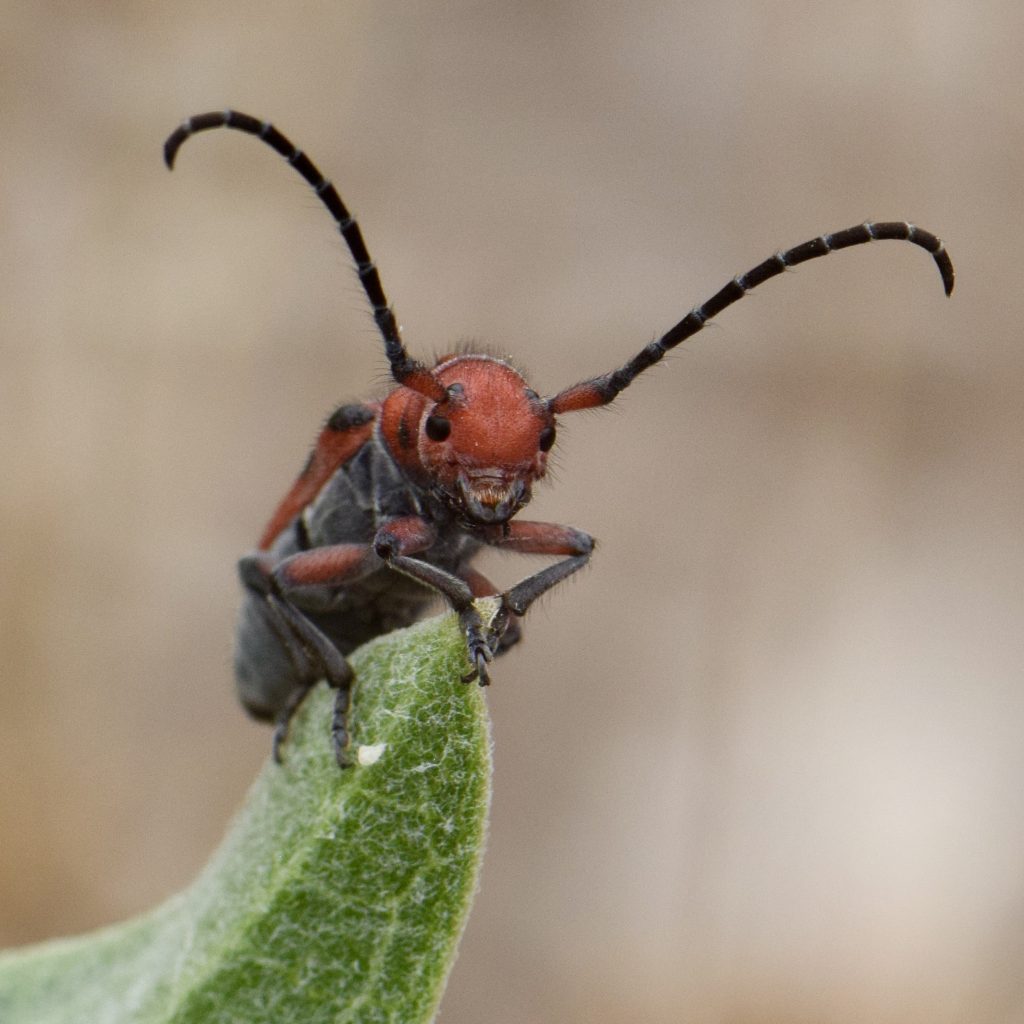
Both the adult and larval stages of T. femoratus rely on milkweed as their sole food source. Adults eat the leaves and flowers and larvae nibble on the roots. As with Monarch Butterflies, which also feed on milkweed, the beetles get some protection by ingesting the toxins in the plant. Their red color is a warning, alerting predators that it doesn’t taste good.
The Red Milkweed Beetle eats the poisonous latex by using a clever trick. First, it gnaws a vein on a healthy leaf. Then, it allows the milky juice to drain from the area. Finally, it eats the leaf to the outside of the initial bite. Apparently, if the beetle accidentally eats too much latex, the goo can harden, sealing up the insect’s mouth. If it does get some liquid with its meal, it will wipe its mouthparts on the leaf to clear it.
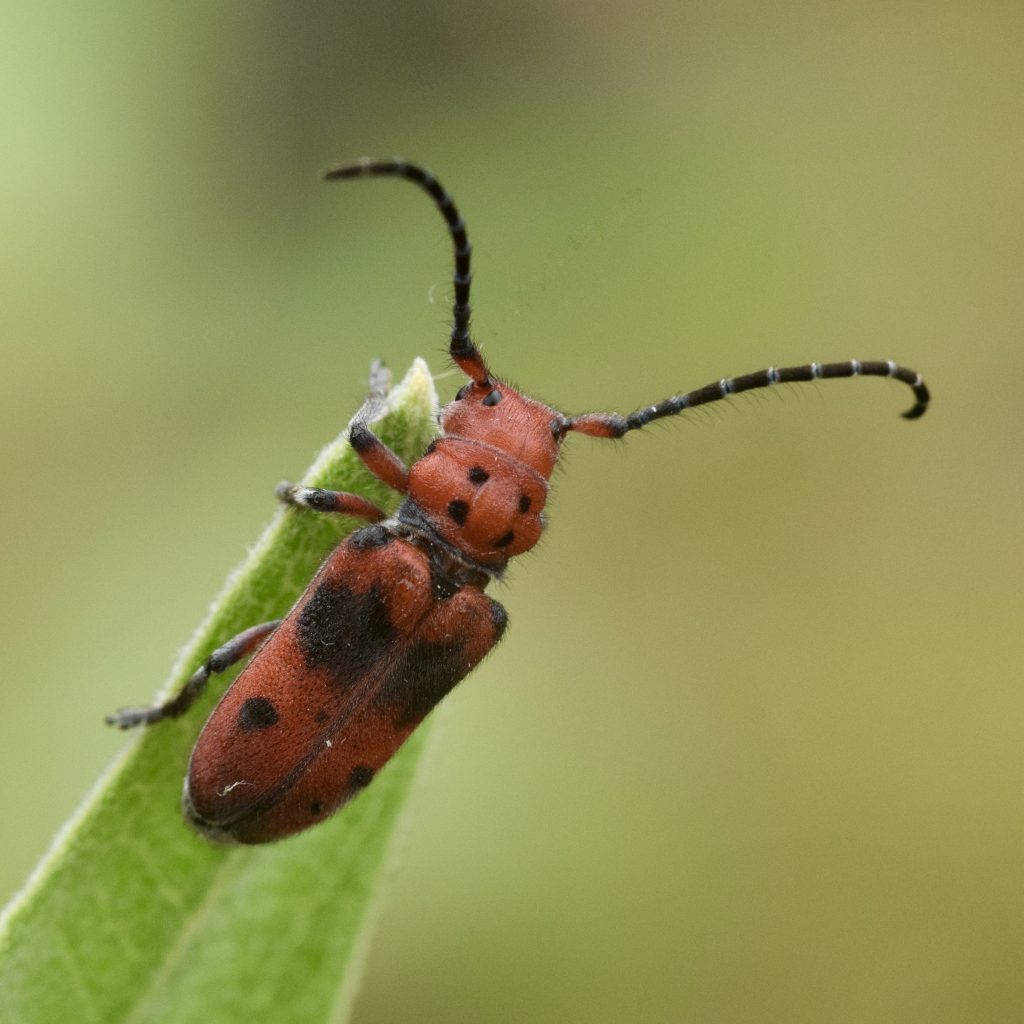
Red Milkweed Beetles have another fascinating trait: They make both squeaks and purrs. According to an article linked below, if the beetles are safely in a jar with some food, you can hear “a soft, almost continuous purring noise.” When the beetle is threatened, placed on its back, or stuck in a milkweed blossom, it emits a “shrill squeak.” Both sounds are made by structures on the upper and middle areas of the thorax.
I’m not sure if they’re still there, but a couple of T. femoratus were on the milkweed plants in front of the White Oak Pavilion a couple of weeks ago.
Stay curious!
See more of Karen’s work here.
Sources:
Description of how the adult beetle feeds: https://www.cambridgeday.com/2021/07/17/the-red-milkweed-beetle-may-behave-like-a-pest-but-let-it-eat-coexisting-with-monarch-butterflies/. Accessed 8/17/26.
1957 paper that includes description of red milkweed beetle sounds: https://files.commons.gc.cuny.edu/wp-content/blogs.dir/20796/files/2022/02/Alexander57_OhioJSci_soundprod.pdf. Accessed 8/17/26.
All photos by Karen Richards.